Nguyen Cao Thuong (1918–2003)
The Unbroken Continuum of History (Dòng Chảy Không Ngắt Quãng Của Lịch Sử)
signed and dated (lower right)
oil on canvas
123 × 290 cm. (48 3/8 × 114 1/8 in.)
executed in 1989–1990
NGUYEN CAO (KAO) THUONG, "THE UNBROKEN CONTINUUM OF HISTORY", 1989-1990, OR HISTORY TOLD AS AN UNBROKEN CONTINUUM
Between 1980 and 1990, following his retirement in October 1980, Nguyen Cao Thuong did not withdraw from artistic life. On the contrary, he maintained a steady presence, both within social engagement and artistic practice. He participated in grassroots movements, was elected as a representative to the ward People’s Council, and taught at the Ho Chi Minh City University of Fine Arts as a visiting lecturer. This was not a period of closure, but one of continuation, in which what had been formed earlier was sustained with a certain degree of quiet consolidation.
During this time, he continued to work consistently, remaining faithful to the themes that had accompanied him throughout his career: revolution, patriotism, and the figure of President Ho Chi Minh. The painting “Uncle Ho Reading the Declaration of Independence (1988), stands as a clear marker, demonstrating his continued commitment to historical and revolutionary subjects in the late 1980s, at a moment when both society and artistic language were beginning to shift.
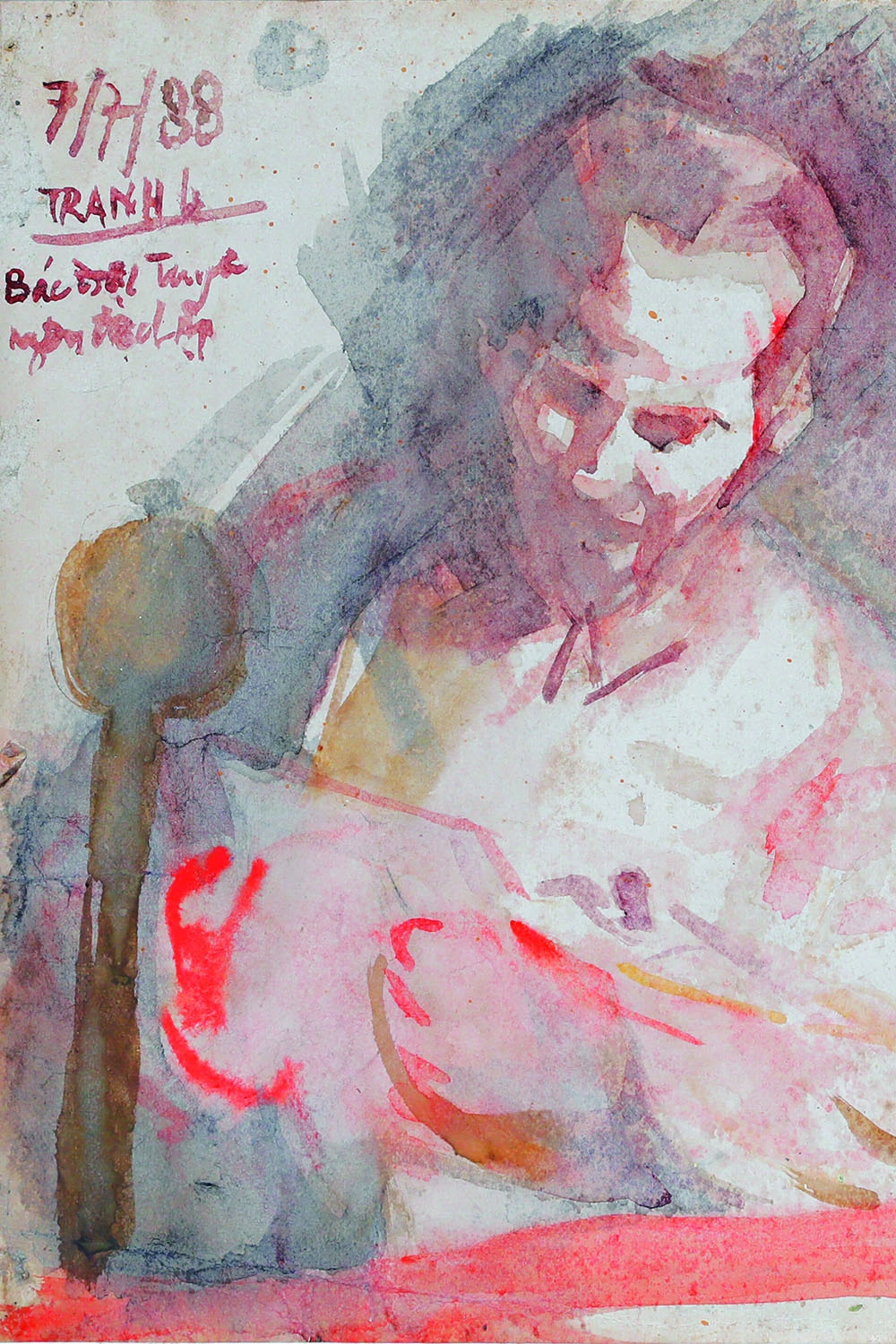
This work must be understood within that context. It is not a single, isolated composition in the conventional sense, but an extended pictorial field, closer in nature to a mural or a historical tableau. There is no single focal point in purely visual terms, but rather a continuous movement, linking past to present, thought to action, and action to outcome.
At its centre, Ho Chi Minh is depicted seated, his hands interlaced, his gaze turned slightly aside. There is no gesture of action, no posture of command. He appears instead as a figure in reflection, rather than as a political actor. The surrounding tones are softer, creating a zone of stillness within the composition. It is precisely this stillness that prevents the painting from dispersing. Ho Chi Minh is not the focal point in a visual sense, but the intellectual axis upon which the work is structured.
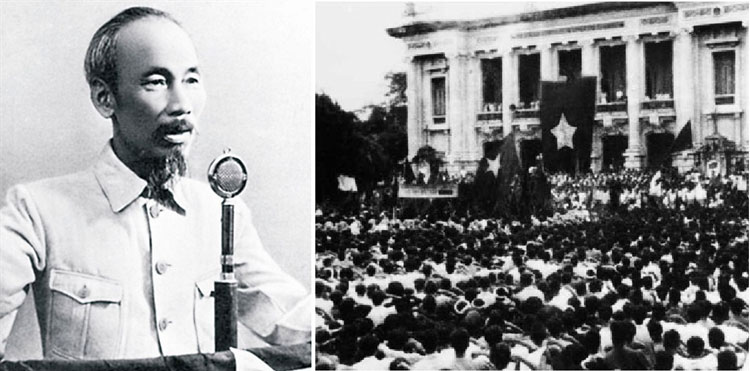
Above is Ba Dinh Square, Hanoi. The detail is not large, yet it is exact. It evokes the closing days of August 1945, when President Ho Chi Minh appeared before the public, greeted the crowds, and declared the formation of a new government. The gatherings of the people at this site are not directly described, yet they remain present, as a layer of memory. The site, therefore, is not only architecture, but a marker of time.
To the left lies the past, the painter does not reconstruct a specific event, but establishes a condensed field of images. Bodies overlap within a compressed space, suggesting a condition of subjugation under the colonial order, rather than a direct depiction of protest. Faces are not individualised, but appear as a collective mass, present as a body rather than as separate identities.
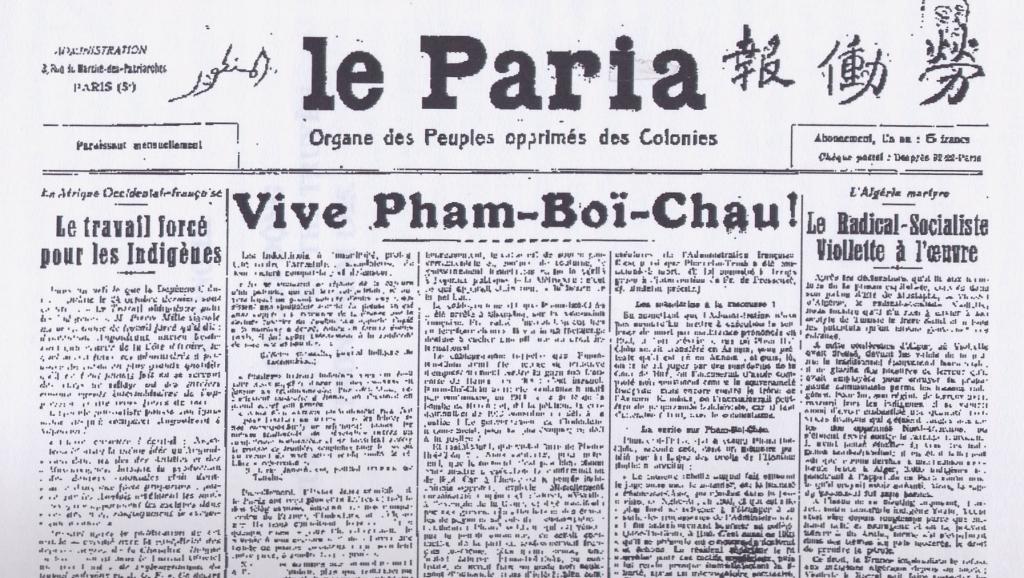
Above, a young man, possibly Nguyen Ai Quoc in his early years absorbed in reflection. On the table appears the newspaper Le Paria, a significant detail. It is not merely a publication, but an intellectual space, one that gathered the voices of colonised peoples, from Indochina to Africa and the West Indies. Its presence in the painting is not illustrative alone, but establishes a connection between intellectual activity and political action.
Around him are images of a more clearly symbolic nature: the revolutionary leader Lenin with the red flag and the hammer and sickle; the composition operates as a historical montage, in which layers of oppression, awareness, and action are held together within a single field. However, many parts in this painting are not completed in the conventional manner, but retain the quality of sketch. This creates the impression that the images are still in formation, not yet stable. The palette of red, black, and grey emphasises a state of tension, conflict, and the incompleteness of history at this stage.
To the right, the atmosphere changes perceptibly. The space opens, and the light becomes warmer. President Hồ Chí Minh stands among the people, no longer separated as an individual, but situated within a collective presence. Beside him, figures suggestive of Ton Duc Thang and Le Duan may be discerned, though they are not treated as strictly realistic portraits. Around them are farmers, workers, and women, representing different strata of society. The figures are rendered with restraint, almost without individualisation, so that the emphasis rests not on separate individuals, but on the collective idea and the flow of history.
The presence of Hồ Chí Minh, Tôn Đức Thắng, and Lê Duẩn operates not merely as a gathering of historical individuals, but as a symbolic structure of continuity within the Vietnamese revolution. Hồ Chí Minh appears as the spiritual origin and the legitimising foundation of the revolution. Tôn Đức Thắng evokes the continuity of the State after 1969, a figure associated with stability, moral authority, and national unity. Meanwhile, the figure at the far right, suggestive of Lê Duẩn, may be read as a symbol of organisational power and the phase of post-war political consolidation, when the revolution moved from the struggle for power towards the construction and maintenance of a unified State structure.
Together, the three figures form a continuous axis extending from revolutionary origin, to the continuity of the State, and finally to the consolidation of authority in the post-war period. It is this alignment that situates the work within the closing years of the 1980s, when Vietnam was entering the era of Đổi Mới, amid historical transformation and the need to reaffirm national continuity after decades of war and upheaval.
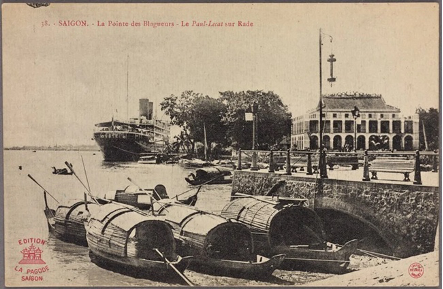
Behind them appears a fleeting detail, yet not an accidental one: the area of Bến Nhà Rồng, under its colonial name La Pointe des Blagueurs. This is the place from which Nguyễn Tất Thành departed Vietnam in 1911, initiating a journey that would extend over more than three decades. Its presence, though positioned in the background, establishes a closed temporal axis: from departure to return, from search to formation.
What is at stake lies not only in the subject, but in its treatment. The left side retains the character of a sketch, unresolved, while the right is brought to a greater degree of completion. This distinction is not incidental. It reflects directly the movement from idea to realisation, from uncertainty to form.
This also signals a broader moment. By the late 1980s, in the context of Đổi Mới, the art of Vietnam began to shift. While still operating within the framework of socialist realism, many artists no longer adhered to its earlier rigidity. Here, Nguyen Cao (Kao) Thuong retains the propagative structure, yet does not close it entirely. Certain parts remain open to perceive the process of image-making itself.
The work, therefore, is not only a painting of revolution. It is also a painting of how revolution is narrated.
Tran Dinh Thuc Doan
Researcher & Archivist