Nguyen Cao Thuong (1918–2003)
Revolutionaries
signed and dated (lower left)
oil on canvas
95 × 135 cm. (37 3/8 × 53 1/8 in.)
overall: 109 × 149 cm. (42 7/8 × 58 5/8 in.) including frame
Painted in 1985
NGUYEN CAO (KAO) THUONG, "REVOLUTIONARIES", 1985, OR THE HOUR WHEN THE NAMELESS ENTERED HISTORY
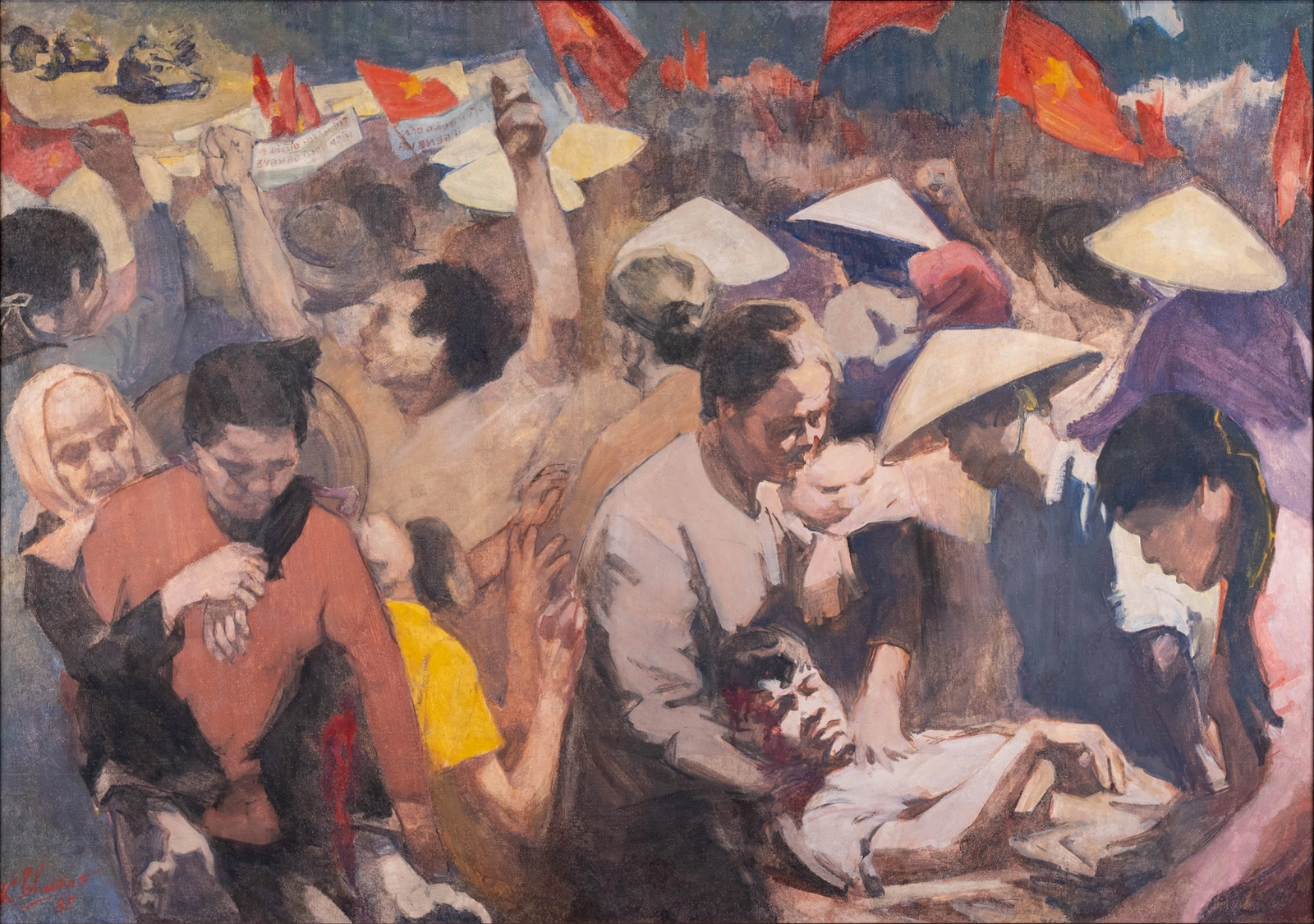
Executed in 1985, Revolutionaries belongs to the period of Nguyễn Cao (Kao) Thương’s 68, a moment when memory had risen to stand beside direct sight as one of painting’s essential powers. The work recalls the after-history of the Geneva Accords, that solemn covenant which once prescribed free general elections in both North and South within two years, only to be set aside thereafter by Ngô Đình Diệm. Yet Nguyễn Cao Thương does not render history as a cold political thesis. He restores it to the multitude, placing it among unarmed hands, the rims of Vietnamese conical hats, bodies marked by wounds, red flags, banners, and the slow, unceasing current of the people.
The composition is tightly compressed, as though scarcely a space for breath remained. Above, no broad vault of sky is opened; beyond, no tranquil distance is granted to the resting eye. The beholder is drawn into the midst of a mass in motion under the pressure of necessity. At the right centre, a wounded man in white, blood still visible, falls backward, sustained by those around him. Nearby, an elderly woman in a white headscarf, her leg still marked by a bleeding wound, is carried onward, her frail body yet bearing the signs of endurance. In such parts, political history is transfigured into human presence. The painting affirms that history is borne forward not by slogans alone, but by hardship, suffering, gestures of care, and sacrifice.
Above the crowd, red flags and banners invoke Geneva: “IMPLEMENT THE GENEVA AGREEMENT JUSTLY.” Such details anchor the work in a precise political memory: the demand that legitimate rights be honoured in practice. In the upper left, tanks or armoured vehicles emerge at a distance, cold, mechanical, and impersonal. They do not dominate the painting. Instead, they are visually subdued by the scale and moral gravity of the assembled multitude. Opposed to machinery stand hands, human bodies, banners, and the ethical authority of disciplined, peaceful resistance.
The palette is restrained yet retains an inner luminousity. Earth browns, ashen blues, violet greys, and chalk whites are awakened by red flags and brief flashes of yellow. Even within suffering and sorrow, Nguyễn Cao Thương allows light to endure. Therein resides the painter’s optimism: not the exultation of triumph, but the virtue of endurance.
Though formed within the discipline of Socialist Realism, Nguyễn Cao Thương nonetheless refused the rigidity of propaganda. His brushwork remains searching, generous, at moments almost sketch-like. Forms emerge, dissolve, and return again, as memory itself continues to move. Revolutionaries is therefore not merely a faithful political image, but a grave and powerful meditation on history, sacrifice, and belief. Its deepest subject is not victory, but the dignity of ordinary men and women carrying history forward.
Tran Dinh Thuc Doan
Researcher & Archivist